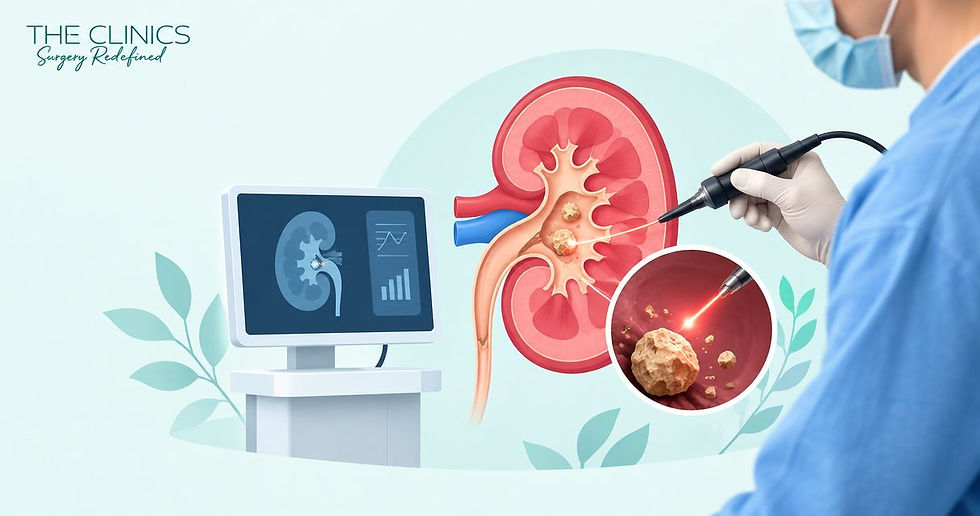
Best treatment options for prostate enlargement in 2026

Best starting point for bothersome, uncomplicated symptoms: an alpha-blocker after assessment. Best for mild symptoms: monitored lifestyle changes. Best for substantial obstruction: an individually selected procedure, not a universal winner. This 2026 guide compares prostate enlargement treatment options and explains when each belongs in your care plan.
TL;DR
Prostate enlargement treatment options depend on symptom burden, prostate size, bladder emptying and complications.
Alpha-blockers relieve symptoms; 5-alpha-reductase inhibitors help selected patients with an enlarged prostate over time.
TURP and HoLEP treat obstruction, but require discussion of bleeding, ejaculation changes and recovery.
The Clinics offers urology assessment in South Delhi; choose treatment after diagnosis, not from a procedure name.
Why this matters
A weak stream, frequent urination or repeated night-time bathroom trips do not automatically mean you need prostate surgery. Benign prostatic enlargement can cause these symptoms, but infection, bladder problems and other conditions also need consideration.
Being unable to pass urine requires urgent medical assessment. Fever with urinary symptoms, visible blood or significant pain also needs prompt attention rather than self-treatment.
At The Clinics, patients in Green Park, Hauz Khas and the wider Delhi NCR area can seek urology assessment. The useful question in 2026 is not which treatment sounds newest, but which treatment addresses your diagnosis and priorities.
What makes the best prostate enlargement treatment?
Compare treatments against these criteria before comparing procedure names:
Symptom burden: How much do urgency, poor flow and interrupted sleep affect you?
Prostate anatomy: Size and the shape of obstructing tissue influence treatment selection.
Bladder emptying: Retained urine, recurrent retention and kidney effects can change the urgency of treatment.
Sexual priorities: Discuss erections, ejaculation and fertility before starting medication or agreeing to surgery.
Medical suitability: Other illnesses, blood pressure and medicines affect safety.
Treatment burden: Consider ongoing tablets, anaesthesia, catheter care, follow-up and possible retreatment.
The International Prostate Symptom Score helps describe symptom severity: 0–7 points is mild, 8–19 points is moderate, and 20–35 points is severe. The score supports assessment; it does not determine treatment by itself.
Prostate enlargement treatments at a glance
Use this 2026 comparison as a discussion guide, not a prescription. These options serve different needs, so their order is not a claim that one treatment beats every other treatment.
Option | Best for | Main benefit | Key limitation |
Monitored lifestyle changes | Mild, manageable symptoms without complications | Avoids medicine and procedural side effects | Does not remove obstruction |
Alpha-blockers | Bothersome symptoms needing relatively prompt relief | Relaxes muscle around the prostate and bladder outlet | Does not shrink the prostate |
5-alpha-reductase inhibitors | An enlarged prostate with progression risk | Gradually reduces prostate volume | Slow onset and possible sexual side effects |
Combination medication | Bothersome symptoms plus significant enlargement | Combines symptom relief with longer-term progression management | Adds medication burden and adverse effects |
Daily tadalafil | Urinary symptoms alongside erectile dysfunction | Can address both concerns | Unsafe with nitrates; not a solution for retention |
TURP | Obstruction requiring tissue removal | Established endoscopic treatment | Bleeding and ejaculation changes require discussion |
HoLEP | Larger prostates needing substantial tissue removal | Removes obstructing tissue through the urethra | Requires specific expertise and has procedural risks |
1. Monitored lifestyle changes: best for mild symptoms
Watchful waiting means monitoring symptoms while making practical changes, not ignoring the condition. Your clinician first checks that symptoms are manageable and that complications do not require active treatment.
Reduce evening drinks if night-time urination is troublesome, without deliberately dehydrating yourself. Reviewing caffeine, alcohol, constipation and medicines that worsen urination can also help.
Monitored lifestyle changes pros:
Avoids medication-related dizziness or sexual side effects.
Lets you identify habits that aggravate symptoms.
Keeps treatment proportional to your current discomfort.
Monitored lifestyle changes cons:
Does not shrink the prostate or remove obstructing tissue.
Requires follow-up and reassessment if symptoms change.
Best for: Mild symptoms that you can live with, without retention or other complications.
Verdict: Choose monitoring when symptoms are manageable; do not use it to postpone assessment of worsening emptying.
2. Alpha-blockers: best for relatively prompt symptom relief
Alpha-blockers, including tamsulosin and alfuzosin, relax smooth muscle around the prostate and bladder outlet. They can improve urinary symptoms without reducing prostate size.
Your clinician should review blood pressure, falls risk and other medicines before prescribing. Tell your eye surgeon if you take or have previously taken an alpha-blocker, particularly before cataract surgery.
Alpha-blocker pros:
Can improve symptoms sooner than prostate-shrinking medication.
Does not require a procedure.
Can form part of combination treatment when appropriate.
Alpha-blocker cons:
Can cause dizziness, postural low blood pressure or ejaculation changes.
Does not provide the same protection against enlargement-related progression as a suitable 5-alpha-reductase inhibitor.
Best for: Bothersome urinary symptoms when assessment supports medication rather than immediate intervention.
Verdict: Consider an alpha-blocker for symptom relief, with a planned review of benefit and side effects.
3. 5-alpha-reductase inhibitors: best for enlargement-related progression
Finasteride and dutasteride reduce hormonal stimulation of prostate growth. They are most useful when the prostate is demonstrably enlarged and longer-term progression is a concern.
These medicines work gradually over months rather than providing immediate relief. They also lower prostate-specific antigen, or PSA, so your clinician must interpret subsequent PSA results with treatment in mind.
5-alpha-reductase inhibitor pros:
Can reduce prostate volume over time.
Can reduce the risk of acute retention and future surgery in suitable patients.
Offers a medication-based approach to enlargement itself.
5-alpha-reductase inhibitor cons:
Delayed improvement makes it unsuitable as immediate relief for retention.
Can cause reduced libido, erectile difficulties or ejaculation changes.
Best for: An enlarged prostate where reducing progression risk matters.
Verdict: Consider this treatment for confirmed enlargement, not simply because urinary symptoms are present.
4. Combination medication: best for symptoms plus significant enlargement
An alpha-blocker and a 5-alpha-reductase inhibitor address different parts of the problem. The alpha-blocker targets muscle-related resistance, while the second medicine gradually addresses prostate volume.
Combination treatment is not automatically better for every patient. Its additional benefit must justify taking more medication and accepting a wider side-effect profile.
Combination medication pros:
Addresses current symptoms and longer-term progression risk.
Can suit patients whose prostate enlargement makes a single medicine insufficient.
Allows a treatment plan without proceeding directly to surgery.
Combination medication cons:
Can combine dizziness with sexual side effects.
Requires follow-up to check response, tolerability and continuing need.
Best for: Bothersome symptoms together with an enlarged prostate and meaningful progression risk.
Verdict: Discuss combination treatment when both symptom control and enlargement need attention.
5. Daily tadalafil: best for urinary symptoms with erectile dysfunction
Daily tadalafil can improve urinary symptoms and erectile function in selected patients. It does not shrink the prostate, and symptom improvement should not be confused with correction of significant obstruction.
A medication review is essential. Tadalafil must not be taken with nitrates, and combining it with blood-pressure-lowering medicines requires clinical assessment.
Daily tadalafil pros:
Can address urinary symptoms and erectile dysfunction together.
Provides a non-procedural treatment choice.
Makes sexual-health priorities part of treatment planning.
Daily tadalafil cons:
Can cause headache, flushing, indigestion or blood pressure effects.
Does not replace drainage or procedural assessment for urinary retention.
Best for: Patients with both urinary symptoms and erectile dysfunction who have no contraindication.
Verdict: Consider tadalafil when both concerns matter, after checking cardiovascular history and medicine interactions.
6. TURP: best for established endoscopic obstruction treatment
Transurethral resection of the prostate, or TURP, removes obstructing prostate tissue using an instrument passed through the urethra. It does not require an external abdominal incision.
TURP becomes relevant when symptoms remain troublesome despite suitable treatment, or when obstruction causes complications. Prostate size, general health and the exact technique influence suitability.
TURP pros:
Directly removes tissue causing obstruction.
Is an established surgical option with a substantial evidence base.
Provides tissue for laboratory examination.
TURP cons:
Can cause bleeding, infection, urethral narrowing or temporary urinary difficulties.
Frequently changes ejaculation; semen can enter the bladder rather than leave through the penis.
Requires anaesthesia and usually temporary catheter care.
Best for: Patients needing tissue-removing surgery whose anatomy and health suit TURP.
Verdict: Consider TURP when obstruction warrants surgery, after discussing ejaculation and recovery explicitly.
7. HoLEP: best for larger prostates needing tissue removal
Holmium laser enucleation of the prostate, or HoLEP, separates obstructing prostate tissue from its surrounding capsule through the urethra. The tissue is then removed from the bladder.
HoLEP can treat a broad range of prostate sizes and is particularly relevant to larger glands. The procedure requires specific surgical expertise; a laser label alone does not establish suitability or quality.
HoLEP pros:
Can remove substantial obstructing tissue.
Is suitable across a broad range of prostate sizes.
Provides tissue for laboratory examination.
HoLEP cons:
Can cause temporary leakage, urinary irritation, bleeding or infection.
Commonly changes ejaculation.
Requires anaesthesia, catheter planning and an experienced operating team.
Best for: Larger prostates or substantial obstruction where an experienced surgeon recommends enucleation.
Verdict: Discuss HoLEP for significant tissue removal, not because “laser” implies risk-free treatment.
How to choose safely in 2026
Start with diagnosis, then compare options. A consultation usually covers symptoms, examination, urine testing and medication history; ultrasound, flow testing, residual urine measurement and PSA testing are selected according to your circumstances.
Use this sequence:
Symptom assessment: Describe flow, urgency, night waking, pain and any retention.
Diagnostic checks: Establish the likely cause and whether complications are present.
Treatment discussion: Compare monitoring, medicines and appropriate procedures.
Follow-up plan: Agree how improvement, side effects and worsening symptoms will be assessed.
Diagnosis and complication checks come before choosing medication or a procedure.
Ask about other minimally invasive options if preserving ejaculation is a priority. Prostatic urethral lift and water-vapour treatment suit selected patients, but anatomy, expected relief and possible retreatment need discussion; this guide does not confirm their availability at The Clinics.
For prostate enlargement treatment options at The Clinics, request an individual assessment rather than a preselected operation. You can enquire about an appointment and ask which records to bring.
How these options were ranked
This 2026 guide orders treatments by distinct clinical use cases, using symptom burden, anatomy, progression risk, sexual priorities and treatment burden. It is not a head-to-head trial or a claim that every listed treatment is offered at The Clinics.
Which treatment should you choose?
For uncomplicated, bothersome symptoms, start by discussing medication; for retention or complications, prioritise prompt urology assessment. Mild symptoms often justify monitoring, while confirmed enlargement can make prostate-shrinking medication relevant.
For a procedure, compare the proposed operation with alternatives suited to your anatomy. Request an itemised estimate covering the planned procedure, anaesthesia, hospital care, catheter needs and follow-up, and clarify which items are separate.
Patients travelling to Delhi in 2026 can ask The Clinics about remote consultation before travel and international-patient coordination. Confirm accommodation or local-travel arrangements individually; do not assume these services are included in treatment.
FAQ
What's the best treatment for an enlarged prostate?
The best treatment depends on symptom severity, prostate anatomy, bladder emptying and complications. Monitoring suits some mild cases, medicines suit many bothersome cases, and procedures address obstruction when clinically indicated.
Can an enlarged prostate be treated without surgery?
Yes, many patients can manage symptoms with monitored lifestyle changes or prescription medicines. Retention, recurrent complications or persistent symptoms can change that recommendation.
Is laser prostate surgery better than TURP?
Neither is universally better. HoLEP and TURP differ in technique and suitability, so compare prostate size, surgical expertise, bleeding considerations, ejaculation effects and recovery.
Do prostate medicines affect sexual function?
Some prostate medicines can affect ejaculation, erections or libido. Discuss these priorities before treatment so your clinician can compare suitable alternatives.
Does an enlarged prostate mean prostate cancer?
No, benign prostate enlargement is not prostate cancer. The conditions can coexist, so examination and any recommended testing still matter.
When do prostate symptoms need urgent care?
Inability to pass urine requires urgent medical assessment. Fever with urinary symptoms, significant pain or visible blood also warrants prompt attention.
What should I ask about recovery after prostate surgery?
Ask about catheter care, bleeding, urinary urgency, activity restrictions and when to seek help. Your recovery instructions should reflect the procedure and your health rather than a generic timetable.
One last thing
A smaller symptom score does not prove your bladder is emptying safely. Before accepting relief as treatment success, ask whether residual urine or another objective check needs follow-up. Feeling better and protecting urinary function are related goals, but they are not identical.